If you’ve raised livestock for very long, you’ve probably had one of those moments where you dump out a water tub, scrub it until it looks brand new, fill it back up…and two days later it’s already turning green again. Water management is one of many hands-on challenges covered in our Building Our Pumpkin Patch — Fencing, Goats & Mulch.
That’s been one of my biggest frustrations here at Weaver Family Farms.
Our goats have large water tubs sitting out in the sun.
Our chickens have waterers that get plenty of sunshine too. Keeping chickens outdoors also makes their water setup worth considering alongside the How I Built a 10×75 Predator-Proof Chicken Run (DIY Guide).
During the summer, algae seems like it grows almost overnight.
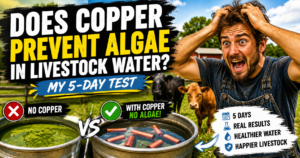
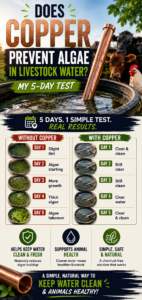
After hearing over and over that dropping copper into livestock water helps slow algae growth, I finally decided to quit wondering if it actually worked and test it myself. For a chicken-specific comparison, see copper in chicken water.
So that’s exactly what I did.
I cleaned out both our goat water and our chicken water, added pieces of copper tubing, and watched what happened over the next five days.
The results honestly surprised me.
If you’re watching the embedded YouTube video in this article, you’ll see exactly how I set everything up and what the water looked like each day.
Why Livestock Water Turns Green So Fast
If you’ve never dealt with algae before, consider yourself lucky.
Out here on our small farm, warm temperatures and full sunshine seem to create the perfect recipe for it.
The water starts out crystal clear.
Then a day or two later…
You start noticing a little green tint.
Pretty soon the sides of the tub become slimy.
Eventually the entire container needs cleaned again.
It doesn’t matter whether it’s goats, sheep, chickens, ducks, or other livestock.
If their water sits in the sun during the summer, algae is usually going to become a problem sooner or later.
Cleaning water containers is just part of owning animals.
But if I could make that chore happen less often, I was definitely interested.
The Copper Trick Everyone Talks About
I’d heard this recommendation for years.
“Just throw some copper pipe in the water.”
Some people claimed it completely stopped algae.
Others said it didn’t do anything.
Like a lot of farm advice, there were plenty of opinions but not many people actually showing what happened after trying it themselves.
Instead of guessing, I figured I’d test it.
After all, it wasn’t an expensive experiment.
If it worked, great.
If it didn’t, I’d know from firsthand experience instead of repeating something I read online.
How I Set Up My Test
I wanted to keep everything as simple as possible.
First, I completely emptied our goat water tub.
Then I scrubbed every bit of algae I could find off the inside.
I wanted to start with a clean container instead of adding copper to water that already had algae growing in it.
While that tub was filling back up, I cleaned our chicken waterer too.
Both started the test completely clean.
The Copper I Used
Instead of dropping one long piece into the water, I cut several shorter sections using my angle grinder.
The longer pieces went into the goat water.
The shorter sections fit nicely inside the chicken waterer.
If you’re planning to try this yourself and don’t want to cut your own pipe, these pre-cut pure copper tubing pieces are very similar to what I used after cutting mine.
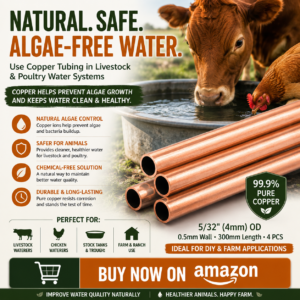
You can also pick up copper pipe at most home improvement stores if you already have something to cut it with.
I Didn’t Add Any Chemicals
One thing I wanted to avoid during this test was introducing other variables.
No bleach.
No commercial algae treatment.
No water additives.
No shade cloth.
No moving the containers.
The only thing I changed was adding copper.
Everything else stayed exactly the same.
That way I’d have a much better idea whether the copper actually made a difference.
Why I Tested Both Goat Water and Chicken Water
I figured if I was going to test this, I might as well see how it worked in different containers.
Our goat water tub is much larger.
It holds considerably more water.
It’s also exposed to full sunlight for much of the day.
The chicken waterer is smaller and shaped differently.
Using both gave me a better overall picture than testing only one container.
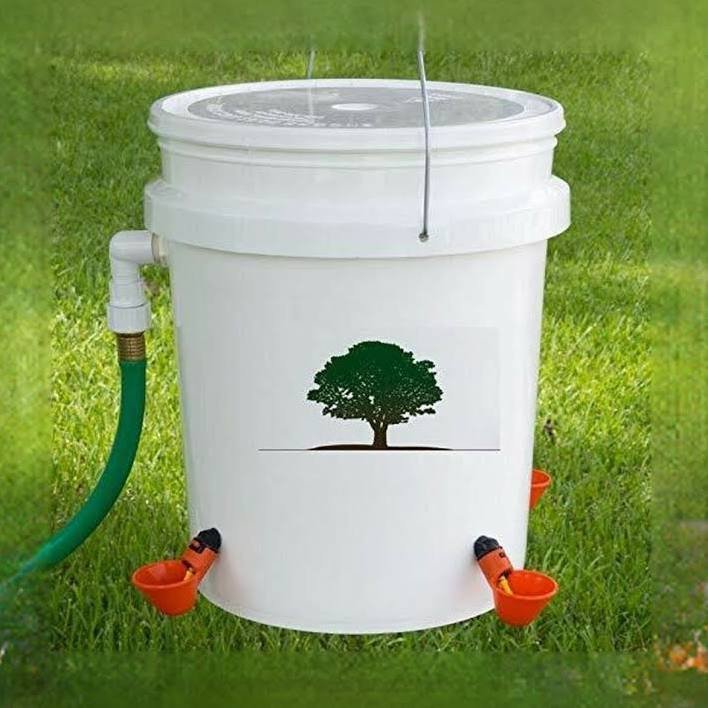
Since our chickens depend on clean water every day, I’ve also shared another project where I built a DIY 5-gallon chicken waterer that has worked really well around our farm if you’re looking for another simple improvement.
Day One
There really wasn’t much to report.
Everything looked exactly like you’d expect after cleaning it.
Crystal-clear water.
Fresh containers.
Copper sitting in the bottom.
Now came the hard part.
Waiting.
Day Three
This was the point where I normally expect to start seeing algae appear.
Especially during the hottest part of summer.
Instead…
The water still looked surprisingly clear.
That definitely caught my attention.
Normally I’d already be seeing some green starting to develop.
This time I really wasn’t.
At that point I started thinking there might actually be something to this old copper trick.


Day Five
By the fourth and fifth day, I was honestly impressed.
Was the water magically perfect forever?
Of course not.
Nothing outdoors works that way.
But compared to how quickly our water usually turns green, there was a noticeable difference.
The water was still much cleaner than I expected.
Based on what I personally saw, I definitely believe the copper helped slow algae growth.
That’s exactly what I was hoping to find out before starting this little experiment.
Does Copper Completely Stop Algae?
Based on my own experience…
No.
I wouldn’t expect copper to eliminate algae forever.
You’re still going to have to dump water.
You’ll still need to scrub containers occasionally.
Fresh water is still incredibly important for healthy livestock.
But if adding a few inexpensive pieces of copper helps stretch the time between cleanings, I think that’s worth it.
Less scrubbing means more time spent working on the hundreds of other things that always need done around a small farm.
And trust me…
There’s never a shortage of those jobs.
Why Might Copper Help Slow Algae Growth?
Copper has been used for a long time in various applications because it naturally has antimicrobial properties. That’s one of the reasons you’ve probably heard this tip passed around by farmers and homesteaders for years.
That said, I don’t think it’s some kind of miracle cure.
My experience suggests it can help slow algae growth, but it doesn’t replace good livestock management.
If your water is already filthy, dropping copper into it isn’t going to magically clean everything up.
You still need to start with clean water.
You still need to dump and scrub containers on a regular schedule.
Think of the copper as another tool that may help you stay ahead of the algae instead of constantly trying to catch up.
A Few Things I Learned During This Test
Even though this was a pretty simple experiment, I came away with a few observations.
First, starting with a completely clean water container matters.
I scrubbed both the goat water tub and the chicken waterer before adding any copper. That gave the copper the best chance to do its job from the very beginning.
Second, I didn’t notice any issues with the goats or chickens drinking from the water during the test. They acted exactly like they always do.
Finally, patience is important.
You’re probably not going to notice much after just a few hours.
The difference became much more noticeable after several days.
This Doesn’t Replace Good Water Management
If there’s one thing I’d stress after doing this experiment, it’s this…
Fresh water is still one of the most important things you can provide your animals.
Even if the copper helps slow algae growth, I’m still going to dump the water regularly.
I’m still going to scrub the containers.
I’m still going to check them every day.
Clean water affects everything from feed intake to overall health, and it’s not something I ever want to cut corners on.
Other Ways I’ve Reduced Algae Around the Farm
Copper isn’t the only thing I’ve done over the years.
A few other habits have helped quite a bit too.
- Dumping and refilling water before it gets really dirty.
- Scrubbing slime off the sides instead of simply topping the water off.
- Keeping containers out of full sun whenever possible.
- Using larger water containers that don’t heat up quite as quickly.
- Checking water every single day during hot weather.
No single trick solves everything.
Usually it’s several small improvements working together.
Could Different Types of Water Containers Make a Difference?
I think they probably could.
Our goat tub is much larger than our chicken waterer, but I still saw encouraging results in both.
Plastic tubs, rubber stock tanks, galvanized tanks, and automatic waterers all absorb and retain heat differently.
How much direct sunlight they receive probably plays a role too.
I’d be interested to hear what kind of results other people have seen using copper in different styles of livestock waterers.
Will I Keep Using Copper?
Yes.
After seeing the results for myself, I don’t really see a downside.
Copper tubing isn’t particularly expensive.
Once it’s in the water, there’s really nothing else to do.
If it helps me scrub algae one day less every week throughout the summer, that’s a win in my book.
Sometimes it’s the little changes that save the most time over the course of an entire season.
Is Copper Safe Around Livestock?
This is probably the biggest question people ask whenever they hear about this trick.
I’m not a veterinarian, and this article isn’t meant to replace professional advice.
I’m simply sharing what I personally did on our farm.
Throughout this test, our goats and chickens drank normally, acted normally, and I didn’t observe any problems.
If you’re raising animals with unique dietary or medical concerns, or you’re unsure whether copper is appropriate for your specific situation, it’s always a good idea to talk with your veterinarian before trying something new.
Frequently Asked Questions
Does copper stop algae in livestock water?
Based on what I observed during my five-day test, I don’t think it completely stops algae. However, it definitely appeared to slow it down compared to what I normally experience during the summer.
How long should the copper pieces be?
I cut mine into several smaller sections so they’d fit inside each water container. The exact length isn’t nearly as important as making sure they fit your particular waterer.
Can I use copper in chicken water?
I did during this experiment, and I used shorter pieces that fit inside our chicken waterer. The water stayed noticeably cleaner than I expected over several days.
Does this mean you’ll never have to clean livestock water again?
Not at all.
You’ll still need to dump, scrub, and refill water regularly. Copper isn’t a replacement for good management. It simply appeared to help slow algae growth during my test.
Where can I buy copper tubing?
I cut mine from a longer piece of copper pipe, but if you’d rather skip cutting it yourself, you can buy pre-cut copper tubing similar to what I used online.
What I’m Going to Keep Watching
Five days gave me a pretty good idea that something was happening, but I’m also curious how this works over several weeks and throughout the rest of the summer.
Will it continue slowing algae growth?
Will I notice any difference after a month?
Will adding more copper make any measurable difference?
Those are questions I honestly don’t know the answer to yet.
That’s one of the things I enjoy about having our little farm. There’s always something new to test, improve, or learn.
If I discover anything different as I continue using copper in our livestock water, I’ll be sure to update this article and make another video so everyone can see the long-term results.
About the Author
Daxon Weaver is the owner of Weaver Family Farms, a small first-generation family farm on 4 acres in rural Missouri. Along with his family, he raises goats, chickens, and puppies, operates a licensed nursery that ships trees across the United States, and enjoys testing practical ideas that make everyday farm life a little easier.
Rather than simply repeating advice found online, Daxon shares firsthand experiences from projects and experiments he has personally completed around the farm. From livestock care and fencing projects to gardening, orchards, equipment modifications, and DIY improvements, every article is written from real-world experience with the goal of helping other small farmers and homesteaders make informed decisions.